Speech and Language Development in Infants and Toddlers: What Parents Should Know
New York Child Resource Center, Inc. works with families across New York City whose children are in the earliest years of development. Many parents come to us with questions about speech, language, listening, gestures, and how their child communicates day to day.
This page addresses some of the most common questions we hear from families. It is not meant to diagnose your child or replace a professional evaluation, but it can help you understand what parents often notice during the infant and toddler years.
Is My Child’s Speech Delay Normal or a Sign of Something More?
Children do not all learn to talk at the same pace. Some children say words early, while others take more time to use sounds, gestures, words, or short phrases. A child’s overall communication matters, not only the number of words they say.
Parents can look at how their child communicates in everyday situations. A child may point, reach, look toward a familiar person, make sounds, bring objects to an adult, or use facial expressions to show what they want or feel. These are all part of early communication.
A delay may be more concerning when a child is not only late to talk, but also has difficulty understanding simple language, using gestures, responding to people, sharing interest, or making progress over time. Some children who talk later catch up, while others may benefit from additional support.
If you feel unsure, it is reasonable to ask questions. Parents often notice small changes before anyone else does, and those observations can be useful when deciding whether a child needs a closer look.
How Can I Help My Child Learn to Talk?
Young children learn communication through repeated, everyday interaction. Talking with your child during meals, dressing, bath time, play, walks, and reading can help connect words to real experiences. Short, simple language is often easier for infants and toddlers to take in.
You can name what your child sees, does, wants, and feels. For example, during play, a parent might say “ball,” “roll ball,” “more blocks,” or “big truck.” The goal is not to quiz the child, but to give them language that matches what is happening in the moment.
Pausing can also help. Some children need extra time to look, gesture, make a sound, or try a word. When adults leave space for a child to respond, communication can become more back-and-forth.
Books, songs, routines, and simple pretend play can give children repeated words and predictable moments. Repetition is helpful because toddlers often need to hear and experience words many times before they use them on their own.
My Baby Doesn’t Respond to Their Name. What Does That Mean?
Many babies begin to respond to familiar voices, sounds, and names during the first year of life, but responses can vary based on age, attention, temperament, hearing, and the situation. A baby may respond differently when tired, busy, hungry, or focused on a toy.
Parents can notice patterns. Does your baby turn toward other sounds? Do they respond to a familiar voice? Do they look up when someone enters the room? Do they react to music, sudden noises, or a favorite routine?
Not responding to a name can have more than one explanation. It may relate to hearing, attention, development, temperament, or broader social communication differences. One missed response does not tell the whole story.
If your baby rarely responds to their name, does not seem to notice familiar voices, or is also not using eye contact, gestures, sounds, or shared attention in expected ways, it may be worth discussing your concerns with a professional.
How Can I Tell If My Child Understands Me?
Understanding language often develops before spoken words. A child may show understanding by looking toward a person or object, following a familiar routine, responding to “no,” giving an object when asked, or moving toward the door when someone says it is time to go.
In the toddler years, many children begin to follow simple directions, especially when the words are familiar and the situation gives clues. For example, “give me the cup” is easier when the cup is right in front of the child. “Go get your shoes” may be harder because it requires remembering and acting on more language.
Parents can watch whether their child understands words without relying only on gestures or routines. If a child follows directions only when an adult points, demonstrates, or repeats many times, they may still be learning what the words mean.
Some children understand much more than they can say. Others may use some words but have trouble understanding language. Both expressive language and receptive language are important parts of communication development.
When Do Babies Start Pointing or Waving?
Gestures are an important part of early communication. Many babies begin using simple gestures, such as reaching, showing, waving, or pointing, during the first and second year of life. These gestures help children communicate before they have many words.
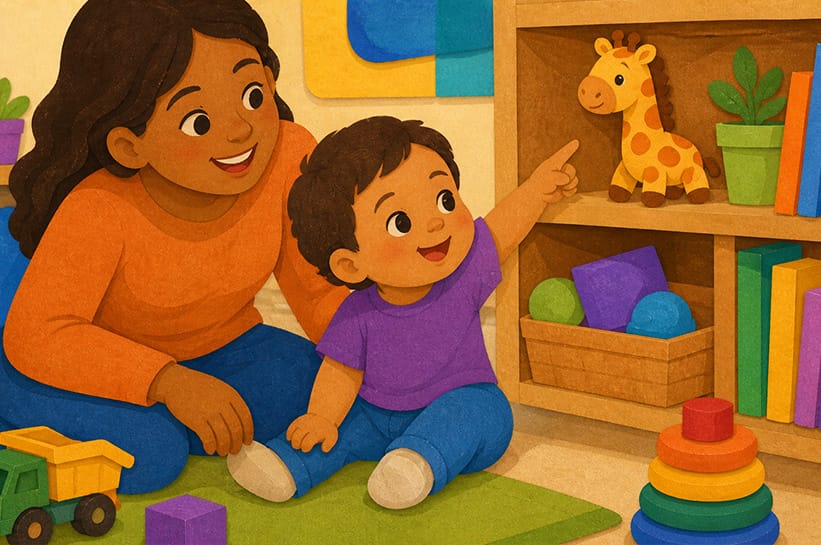
Waving often begins as part of a familiar social routine, such as saying goodbye. Pointing may begin with a child reaching toward something they want, and later may become a way to show interest, ask for help, or share attention with another person.
Pointing to request something and pointing to show something are both meaningful. For example, a child may point to a snack because they want it, or point to an airplane because they want you to look too. That shared moment is part of social communication.
If a child is not yet waving, pointing, showing objects, or using other gestures by the toddler period, parents may want to pay attention to the broader picture. Gestures, eye contact, sounds, understanding, and social interest all work together.
What Does It Mean If My Child Isn’t Babbling by 12 Months?
Babbling is one of the early building blocks of speech. Babies often experiment with sounds before they use true words. This may include repeated sounds such as “ba-ba,” “ma-ma,” or “da-da,” along with squeals, raspberries, and changes in pitch.
Some babies are quieter than others, and not every child follows the same pattern. Still, by around the end of the first year, many babies are using a variety of sounds and are beginning to connect sound-making with attention, play, and interaction.
If a child is not babbling by 12 months, parents can look at related communication skills. Does the child respond to sounds? Do they look toward familiar people? Do they smile, reach, gesture, or vocalize to get attention? Do they seem interested in back-and-forth interaction?
A lack of babbling can sometimes be connected to hearing, oral-motor development, overall development, or differences in social communication. It does not point to one single cause, but it is a reasonable concern to raise with your child’s doctor or with a developmental professional.
When Should My Child Start Using Sentences?
Children usually move from sounds to words, then from single words to short word combinations. Many toddlers begin putting two or more words together around the 19 to 24 month range, with phrases such as “more milk,” “mommy up,” or “go car.” These early combinations may not sound like full adult sentences, but they show that a child is beginning to put ideas together.
As children move from age 2 toward age 3, those word combinations often become longer and more flexible. A child may begin using short phrases to ask for something, describe what they see, protest, greet, or comment during play and daily routines.
By around age 3, many children are using longer phrases and simple sentences. They may ask basic questions, talk about what they are doing, name familiar people or objects, and take part in short back-and-forth exchanges.
Sentence development depends on many earlier skills, including understanding words, using gestures, imitating sounds or actions, and having enough words to combine. A child who has only a few words may not yet have the building blocks needed for sentences.
Parents should also consider whether the child uses language for different purposes. Communication is not only about sentence length. It is also about how a child uses sounds, words, gestures, and attention to connect with other people.
How Do I Support My Bilingual Child’s Speech Development?
Growing up with more than one language does not cause a speech or language disorder. Many children around the world learn two or more languages from an early age. Bilingual children may divide their words across languages, and their vocabulary may look different depending on who they speak with and where they are.
Parents can support a bilingual child by using the language or languages they are most comfortable using. Rich, natural conversation matters more than forcing one language over another. Children benefit from hearing warm, meaningful language from the people closest to them.
It is also common for bilingual children to mix languages at times. This does not necessarily mean they are confused. It may simply reflect the words they know best in each language or the way language is used in their home and community.
If a bilingual child has communication difficulty, concerns may appear across languages, not only in one setting. Looking at the child’s total communication, including words, gestures, understanding, social interaction, and progress over time, gives a clearer picture.
Is It Normal for a 2 Year Old Not to Talk?
Some 2 year olds talk a lot, and some use only a small number of words. There is a wide range in early talking, but by age 2 many children are using words regularly and beginning to combine words into short phrases.
A 2 year old who is not talking may still communicate in other ways. They may point, gesture, lead a parent by the hand, make sounds, use facial expressions, understand familiar directions, or show interest in people and play. Those skills are important to notice.
At the same time, “not talking” at age 2 is worth taking seriously. It does not automatically mean something serious is happening, but it is not something parents need to ignore or explain away. A child’s communication can be supported more effectively when concerns are noticed early.
Parents may want to consider how much the child understands, whether they try to imitate sounds or actions, how they ask for help, and whether they are gaining new communication skills over time.
Should I Be Worried If My 2 Year Old Isn’t Talking Yet?
Worry is not always the most helpful word, but concern can be useful. If a 2 year old is not yet using words, or uses very few words, it is reasonable for parents to ask for guidance. The goal is not to label the child, but to better understand what support may be helpful.
Parents can look at the whole communication picture. A child who is not talking but uses eye contact, gestures, pretend play, sounds, and clear attempts to communicate may look different from a child who is quiet and also does not respond, gesture, imitate, or show shared interest.
It is also important to think about hearing. A child may hear some sounds but still miss parts of speech, especially in noisy rooms or when words are spoken from a distance. Hearing and communication are closely connected in the early years.
If your 2 year old is not talking, has stopped using words they once used, does not seem to understand familiar language, or is not using gestures to communicate, those are good reasons to seek more information.
What Is the Red Flag for Speech Delay?
There is no single sign that explains every child’s speech development. A red flag is usually a pattern that suggests a child may need a closer look. Parents often notice that a child is not using sounds, gestures, words, or understanding in the way they expected for their age.
Some concerns are especially important. These may include loss of words or social skills, limited response to sound or name, little or no babbling by the end of the first year, few gestures, very limited words by age 2, difficulty understanding simple directions, or speech that does not continue to grow over time.
Another red flag is when a child does not seem motivated to communicate. For example, some children may not point, show objects, bring things to a parent, look back and forth between a person and an object, or try to get help when they need something.
A red flag does not mean parents should panic. It means the child may benefit from careful observation and guidance so the family can understand what is happening and what may come next.
Can My Child Have a Speech Delay and Not Be Autistic?
Yes. A child can have a speech or language delay and not be autistic. Speech delays can be related to many different factors, including hearing, development, temperament, environment, motor planning, attention, or other communication differences.
Autism is not defined by speech delay alone. Many autistic children have language delays, but autism also involves differences in social communication, interaction, play, behavior, interests, and sensory responses. Some autistic children speak early or have many words, while some children with speech delay are socially engaged and not autistic.
Parents can look beyond the number of words. Does the child enjoy interaction? Do they share attention? Do they use gestures? Do they imitate? Do they respond to familiar people? Do they play in flexible ways? These pieces help create a fuller picture.
If a child is late to talk, it is appropriate to ask questions without jumping to one conclusion. The important thing is to understand the child’s individual communication profile.
How Can You Tell the Difference Between Speech Delay and Autism in a 3 Year Old?
At age 3, a speech delay may show up as limited words, short phrases, unclear speech, or difficulty putting thoughts into words. Some children with speech delay are very socially connected. They may use eye contact, gestures, facial expressions, pretend play, and back-and-forth interaction even when their spoken language is limited.
Autism may involve broader differences in social communication and behavior. A 3 year old may have difficulty with back-and-forth interaction, limited use of gestures, reduced sharing of interest, less flexible play, strong reactions to changes, repetitive movements, or intense focus on certain objects or routines. Not every autistic child shows the same signs.
The difference is not always obvious from one behavior. A child who does not talk much may still communicate often through gestures and shared attention. Another child may have words but use them mostly to label, repeat, or request, with less back-and-forth social use.
Parents do not have to figure this out alone. When there are questions about speech delay, autism, understanding, gestures, play, or social interaction, a developmental evaluation can help clarify what the child may need.
Questions About Your Child’s Communication?
If you have questions about your child’s communication development, New York Child Resource Center, Inc. is here to help. Our team works with families across all five boroughs of New York City and Nassau County. Call any of our locations to speak with someone who can answer your questions.
Bronx: 718-585-0600
Manhattan: 212-569-1044
Brooklyn: 718-443-3440
To learn more about the services New York Child Resource Center provides, visit our Programs & Services page. For information about developmental evaluations, visit our Child Development Evaluations page. For a general overview of support available for young children, visit What is Early Intervention?